
Most teams don’t struggle with pressing because players are unwilling to work. They struggle because players react too late.
At youth, high school, and even college level in the United States, pressing often turns into chasing. One player runs, others hesitate, and the opponent escapes pressure with one simple pass.
Effective pressing starts with reaction speed — recognizing the moment when the opponent is vulnerable and attacking that moment together.
The following two small-sided games are designed specifically to train reaction, intensity, and immediate collective pressure. Instead of rehearsing defensive shapes, players learn to respond instinctively to pressing triggers.
Why Reaction-Based Pressing Training Matters
In matches, successful ball recoveries rarely come from organized defensive blocks. They come from short chaos moments:
- a poor first touch
- a slow pass
- a player receiving while facing their own goal
- transitions after losing possession
Research in skill acquisition and ecological dynamics consistently shows that players improve decision-making faster when learning happens inside realistic game environments rather than isolated drills.
Small-sided games increase repetitions of these moments dramatically. Players experience dozens of pressing situations in minutes — something a full-field exercise simply cannot provide.
The goal is simple: train players to react first, think second.
Pressing Game 1: Quick Counterpressing Reactions
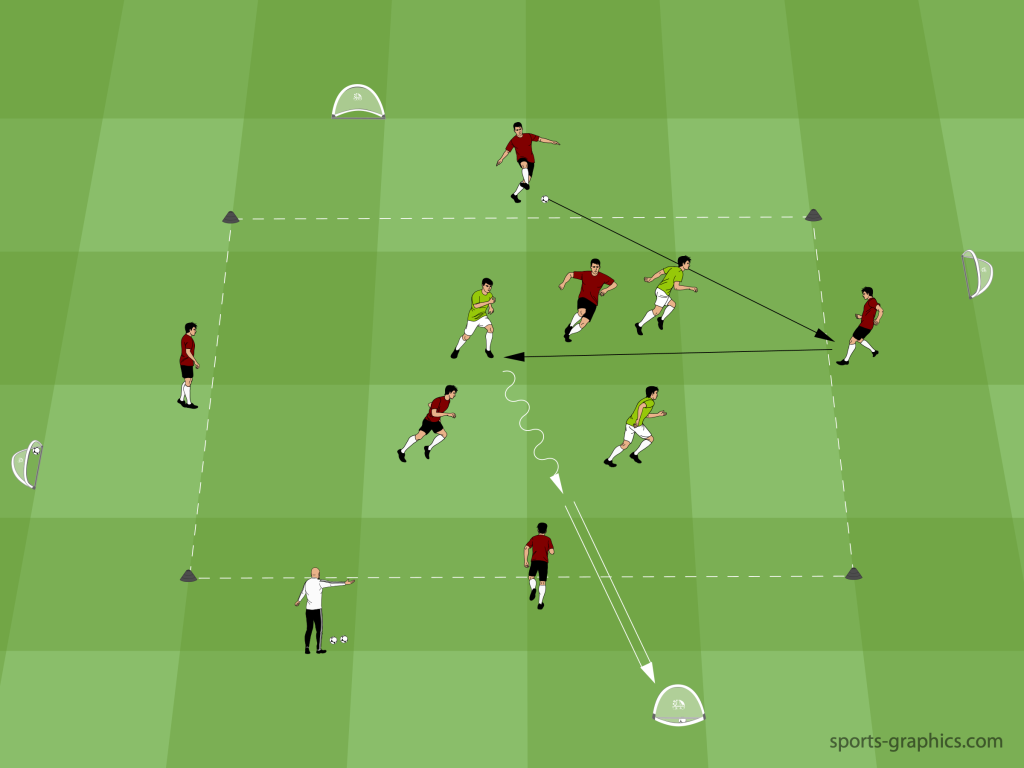
How to Run
Four attackers’ position on the outside lines of a rectangle. Two more attackers are inside of it together with three defenders. Attackers play for possession. If the defenders win the ball they counter to the mini goals.
Key Coaching Points
- Immediate reaction upon the loss of the ball
- Cover the mini goals upon loss of possession
- All players must react immediately
- Sprint first, organize while moving
Why This Game Transfers to Matches
Many American teams struggle not with understanding pressing, but with executing it at match speed.
This game teaches players to recognize counterpressing moments through repetition. Because space is limited and direction is clear, hesitation disappears. Players begin to associate specific visual cues with immediate action.
Over time, pressing becomes a reflex instead of a coach’s sideline instruction.
Pressing Game 2: Pressing pendulum
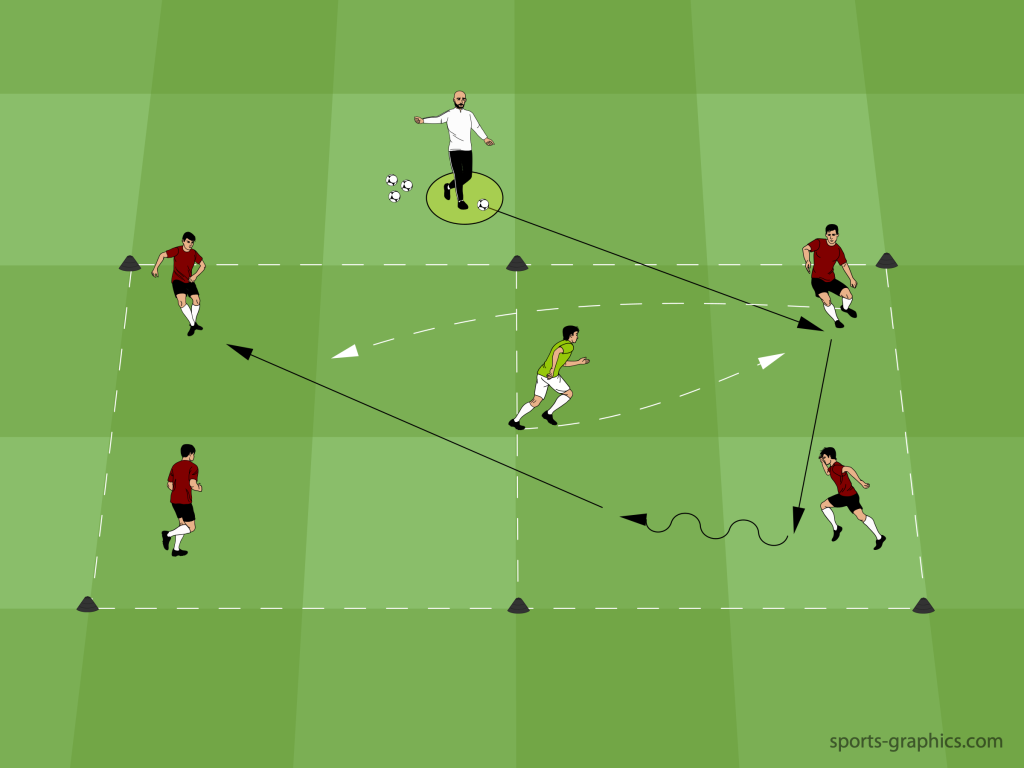
How to Run
Five players organize in a rectangle. Two players on each side and a defender on the midline. The action starts with one pass to one side. Each player needs to use two touches. The goal is to switch the play to the other side. If that is successful, the player that did not play the pass needs to press the other side. If the ball is lost the player that lost it needs to press. Keep the time short (30 sec).
Key Coaching Points
- Quick reactions and high intensities
- Impact the ball carrier with your press
- Drive the ball against pressure
Why This Game Transfers to Matches
This activity gives a high number of repetitions in pressing and specially the intensity of pressing under fatigue. Really impacting the player on the ball plays a crucial role.
Coaching Adjustments for the American Training Environment
Many coaches in the U.S. work with limited training time and mixed ability levels. These games allow intensity without tactical overload.
Practical adjustments include:
- Smaller fields to increase urgency
- Scoring bonuses for quick ball recovery
- Neutral players to support younger age groups
- Time challenges to raise competitive energy
The structure stays simple while the learning remains high.
Final Thoughts
Pressing is not primarily about tactics. It is about behavior under pressure. When players repeatedly experience fast transition moments in training, intensity becomes natural. Teams stop waiting for instructions and start acting together.
If players learn to react faster than the opponent can think, pressing stops being risky — and starts becoming an advantage.