
These days, every kid knows terms like tiki-taka or the through ball into the gap. Top teams like Bayern Munich or Barcelona put their entire focus on possession play. On the other hand, there are also teams that build their game around counterattacks and long balls.
These styles of play are by no means just “kick it long and hope.” Deliberately playing for the second ball requires, just like any other strategy, a high level of tactical understanding and targeted training.
In this article, we show you three exciting training games from coach Steven Turek that focus on the second ball. Turek covers long-ball play in depth in his book Attacking with the Long Ball.

Attacking with the Long Ball

Steven Turek’s guide to attacking with the long ball – technical and tactical principles, match situations and exercises.
Long Balls with a Central Zone
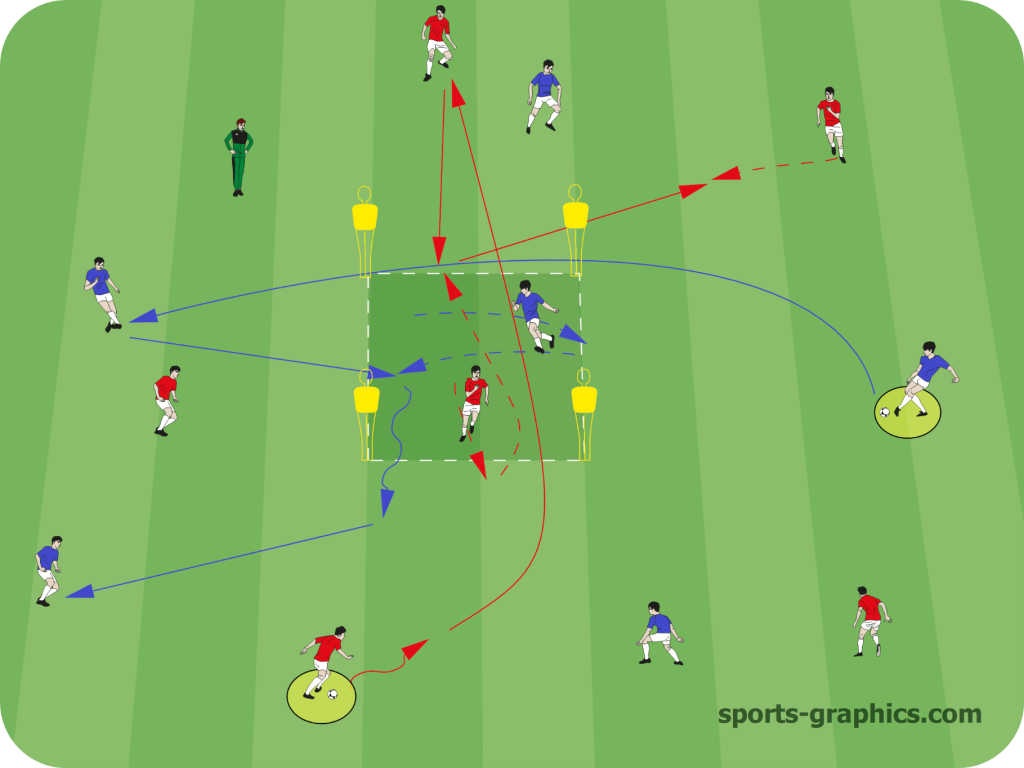
Procedure:
Two groups of six each circulate a ball. One red and one blue player occupy the center zone. When a long ball is played over the zone, it must be laid off first-time to the central player. The player who played the long ball switches into the center.
Coaching Points:
The player in the center should make a short sprint toward the player on the ball. That signals open space, and the long ball can be played. As the ball is played, the central player moves toward the new ball carrier and tries to play it on first-time. Further coaching points are the technique of the long ball and a clean layoff (head, chest or foot) to the central player.
4 vs 2 to 4 vs 2
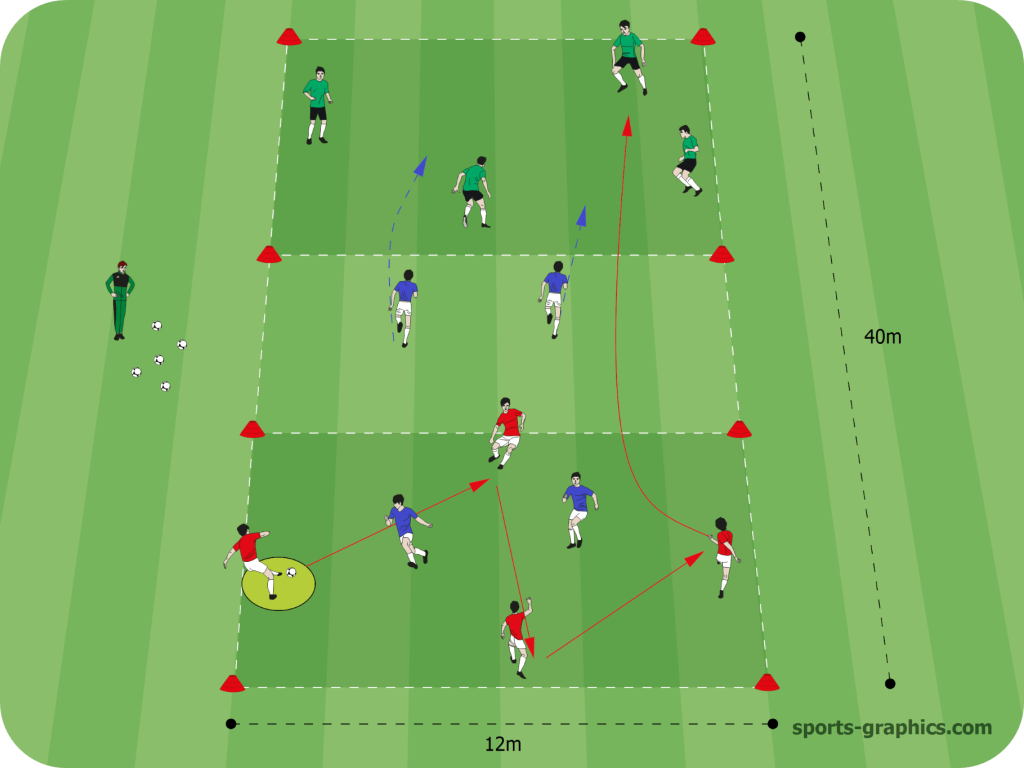
Procedure:
Each area has 4 players. The coach plays the ball into one of the outer areas. As the ball is played in, two blue players also enter that area and try to win the ball. If they succeed, blue switches to the outer zone and red goes into the middle. If red completes 5 passes without a blue player touching the ball, they may try to play a long ball across to green on the other side. If that works too, the other two blue players sprint into green’s area and the remaining blue players return to the center.
Coaching Points:
Because of the looming pressure from opponents, the second ball must be deliberately secured.
Variation:
The team receiving the long ball may head it straight back.
3 (+1) vs 2 to 2 (+1) vs 3 (+1)
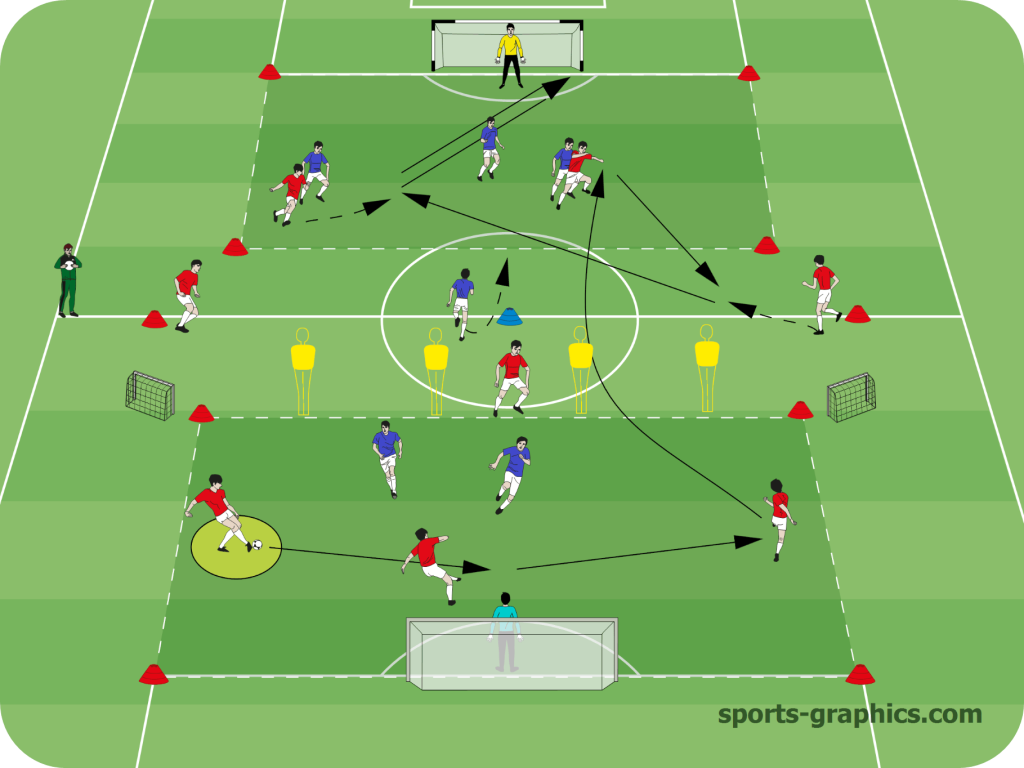
Procedure:
In the first zone, red plays 3 (plus one target player) vs 2. The other zone may only be reached with a long ball. There, red is outnumbered 2 vs 3. When the long ball is played, one red player and the central blue player join in to make it 3 vs 4. If the blue team manages to head the ball straight back into the first zone, blue may attack the full-size goal freely. Play continues until a goal is scored or until blue wins the ball and counters onto one of the mini goals.
Coaching Points:
Red should use the 3 vs 2 overload well to set up a well-aimed long ball. After the long ball, the red player closest to the ball should join the play and secure the second ball.
Variation:
After winning the ball, the blue team may also play a through ball and counter toward the full-size goal.
Attacking with the Long Ball
Steven Turek’s guide to attacking with the long ball – technical and tactical principles, match situations and exercises.