
Why Most Small-Sided Games Don’t Transfer to Matches
Small-sided games are one of the most used tools in modern soccer coaching.
Yet many coaches experience the same problem: players perform well in training, but the behaviors disappear on matchday.
The reason is simple and well-documented in coaching research:
Not every small-sided game creates meaningful transfer to the full game.
According to applied sports pedagogy and ecological dynamics, learning transfer only occurs when training tasks:
- replicate real decision-making demands
- include opponents and pressure
- preserve spatial and tactical reference points
Games that lack these elements may look intense, but they fail to shape match-relevant behavior.
What Makes a Small-Sided Game Transfer to 11v11 Soccer
Before looking at concrete examples, it’s important to understand the principles that separate effective small-sided games from ineffective ones.
1. Direction and Game Objective
Games must include:
- a clear attacking direction
- goals or end zones
- consequences for decision-making
Without direction, players learn possession without purpose.
2. Tactical Reference Points
Effective games maintain:
- width and depth
- identifiable roles
- recognizable team structure
Players must see how their actions connect to real match situations.
3. Decision Density Under Pressure
Transfer happens when players must:
- scan
- decide
- execute
under realistic time and space constraints.
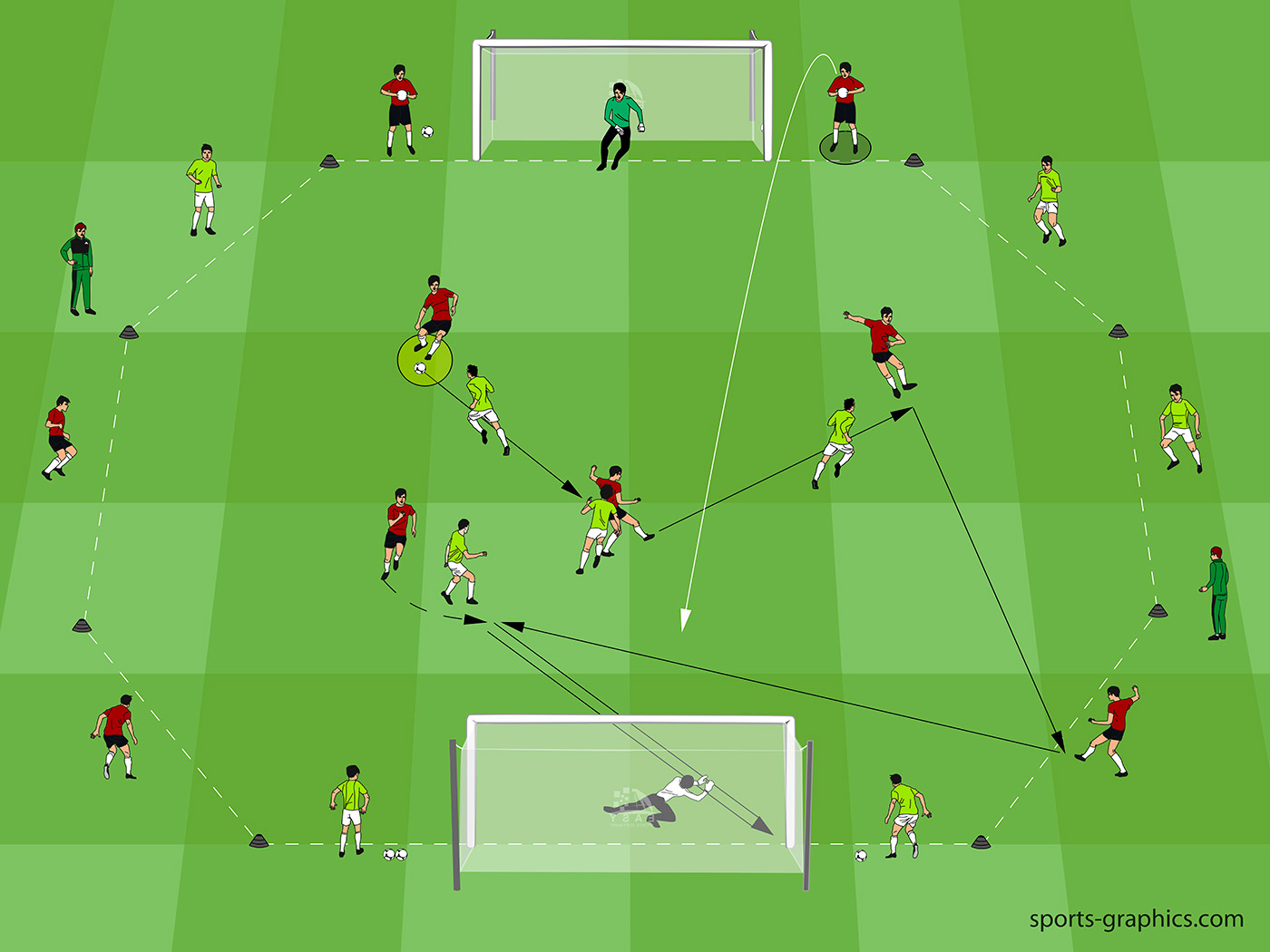
Small-Sided Game #1: 4v4+2 – Heading Duel
How to run
Two teams play a regular 4v4 inside the marked area.
Each team has two neutral bumpers positioned in the attacking half, who can be used to combine in possession. Bumpers are restricted to one touch.
After a goal is scored, the attacking team immediately receives a second ball. This ball is introduced by a throw-in from one of the attacking bumpers, forcing an instant transition moment.
Play for 90 seconds, then rotate teams and bumpers.
Key Coaching Points
- How strikers arrive in the golden zone in front of goal
- Recognizing and defending cut-back situations
- Immediate reactions when transitioning to defend or attack the second ball
Why This Game Transfers to Match Situations
The positioning of the bumpers naturally recreates cut-back situations commonly seen in real matches.
Because the ball is played from wide and slightly deeper zones, attackers are forced to time their movements into the scoring area rather than arriving too early.
The second ball after a goal adds a realistic transition element that is difficult to replicate in traditional small-sided games.
Throw-ins often lead to chaotic and unstructured moments in matches, and this game deliberately exposes players to those situations, demanding quick organization, awareness, and decision-making.
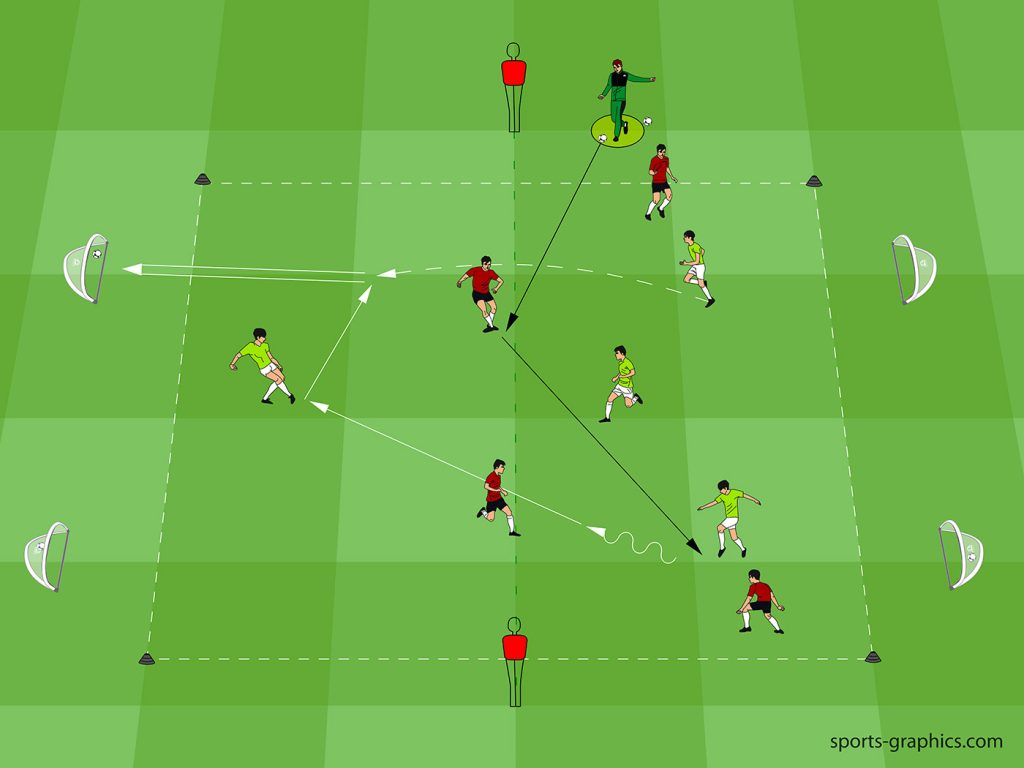
Small-Sided Game #2: 4v3(+1) – Defending lines and counter
How to run
Two attacking players start on the halfway line.
In the attacking half, two attackers and two defenders are positioned.
One additional defender waits in the opposite half.
The exercise starts with a pass from the coach into a central attacking player. The attacking team attempts to score in a 4v3 situation on two mini goals.
If the defending team intercepts the ball, they are allowed to immediately counter-attack towards the opposite direction.
Key Coaching Points
- The three defenders must prioritize protecting central passing lanes and through passes before stepping out to press the ball
- The waiting defender should anticipate interceptions and position themselves accordingly to support the counter-attack
- Quick transitions after winning or losing possession
Why This Game Transfers to Match Situations
From the first pass, the setup resembles a realistic match situation with multiple defensive and attacking lines.
The attacking team is challenged to break lines with forward passes while accepting the risk of losing possession.
At the same time, defenders are trained to recognize passing cues, protect central spaces, and react immediately after regaining the ball.
This balance between attacking ambition and defensive responsibility closely mirrors real match demands, particularly in transition moments after line-breaking attempts.
These small sided games were selected by Saideline – the app that transforms your prompt into easy to use training sessions. Try Saideline today!
From Small-Sided Games to Full Match Behavior
Even well-designed games will not transfer automatically.
Players need help connecting the exercise to the game.
Research in motor learning shows that explicit reflection and visual reinforcement significantly improve transfer.
Key steps for coaches:
- pause the game at key moments
- highlight spatial relationships
- connect decisions to match scenarios
Making Tactical Transfer Visible for Players
One of the biggest challenges in coaching is time pressure during matches.
Verbal explanations alone are often insufficient.
This is where visual communication becomes critical.
Coaches who visually show:
- positioning
- distances
- decision options
help players recognize patterns faster and apply training principles during real games.
Final Thoughts for Coaches
Small-sided games are powerful — but only when designed with intent.
If a game:
- reflects real match problems
- creates realistic decisions
- is clearly connected to 11v11 behavior
it becomes a true development tool, not just an exercise.
The goal is not to run more games — but to create better transfer from training to matchday performance.
Steven Turek is currently the U19 head coach at MLS club Atlanta United. Prior to his international experience, he worked for seven years at the Hannover 96 academy. He has authored multiple coaching books, delivered lectures, and designed coach education programs worldwide.